2025 Gartner® Market Guide — Representative Vendor

Secure Data.
Unleash AI.

You can't truly secure your data or govern your AI without knowing who can reach both. Symmetry unifies identity, data, and AI risk into one view — so you can act, not just observe.

DataGuard — Risk Intelligence ● Live
PII Records — S3 Production Bucket
AWS us-east-1 · 2.4M records · Public access enabled
Critical
Sensitive IP — SharePoint Drive
Microsoft 365 · 847 files · 140 excessive permissions
High
PHI Data — Snowflake Warehouse
Snowflake · HIPAA scope · 12 dormant identities
High
Dev DB Replica — Azure SQL
Azure eastus · Contains production PII copy
Remediating
14.2MRecords
847Open Risks
98.1%Accuracy
14.2B+
Records classified
94min
Avg. time to first findings
98.1%
Classification accuracy
847+
Environments protected
5×
Faster than manual classification
What security teams are sayingReal practitioners. Real environments. No logos required.
"

First DSPM that actually showed us what Copilot was doing with our sensitive data. We found 140 overexposed files in the first hour that had been invisible for months.

CISO
Global Financial Institution · 40,000+ employees
"

We needed DSPM in an environment where no vendor data could ever leave the perimeter. Symmetry was the only option that took that requirement seriously — and deployed in under 4 hours.

VP of Security Engineering
Defense Contractor · Air-gapped deployment
"

We went from not knowing where our PHI lived to having a full compliance map in two days. The identity-to-data graph showed us dormant access we'd had for three years.

Director of Security & Compliance
Healthcare System · HIPAA environment
The Problem

You can't secure
what you can't see

Data sprawl, shadow AI, and permission drift have made traditional security tools inadequate. Most organizations have no idea what sensitive data they hold — or who can reach it.

⚠️
Shadow data multiplying uncontrolled

Dev copies, backups, and shared links create hundreds of untracked sensitive data instances outside your security perimeter.

🔑
Identity and data risk treated separately

Most tools see data or identity — never both together.

🤖
AI systems ingesting ungoverned data

Copilot, ChatGPT plugins, and internal LLMs are pulling from data stores that security teams have never audited.

97%
of organizations have gaps in how they manage cloud data risk
PwC Cloud & Digital Risk Survey
Dormant data grows 5× year-over-year, silently expanding your attack surface
Symmetry State of Data+AI Security Report
74%
of breaches involve excessive privileges and over-permissioned identities
Verizon DBIR 2024
Dormant data
growth per year
1 in 4Identities
zero access 90+ days
$4.9MAvg. breach
cost in 2025
The Platform

Four capabilities.
One unified view.

Data AI Identity

Four products — DataGuard, DataEnforce, AIGuard, and AnomalyDetect — working together across cloud, SaaS, and on-prem. Deployable in your cloud or fully air-gapped.

01
🔍
Symmetry DataGuard

Continuously discover, classify, and inventory sensitive data across structured databases, unstructured files, SaaS, and cloud — including shadow data you don't know exists.

Data AWS · Azure · GCPSnowflakeMicrosoft 365
02
Symmetry DataEnforce

Automatically enforce data security policies at scale. Revoke excess permissions, mask sensitive data, and remediate misconfigurations — without manual intervention.

Data Auto-RemediationPolicy EnforcementLeast Privilege
03
🤖
Symmetry AIGuard

Govern AI access to sensitive data. See exactly which AI agents, Copilot integrations, and LLMs are reaching your most critical data — and enforce boundaries in real time.

AI AI-SPMCopilot SecurityShadow AI
04
📡
Symmetry AnomalyDetect

Detect and respond to data threats in real time with DDR. Surface exfiltration attempts, insider threats, and abnormal identity access patterns before damage is done.

Identity DDRUEBASIEM Integration
Identity × Data Access MapLive
JC
Jane Chen — Sr. Engineer
Last active: 94 days ago · 3 sensitive stores
Dormant Identity
🤖
copilot-service-acct
AI agent · Accessing PII + financial records
Ungoverned AI
RK
Raj Kumar — Data Analyst
Normal patterns · Least privilege enforced
Compliant
VL
vendor-lambda-prod
External vendor · Admin access post-offboarding
Critical
🤖
gpt-plugin-analytics
AI agent · Unreviewed access to data lake
Shadow AI
Unique Differentiator

Identity meets data.
Finally.

Every other DSPM tells you what data is at risk. Symmetry tells you who put it there — and who can reach it right now.

DataGuard — Complete data visibility

Map every sensitive data asset across cloud, SaaS, and on-prem. Know what you have, where it lives, and who can reach it.

DataEnforce — Automatic remediation

Don't just find risk — fix it. DataEnforce automatically revokes excess permissions and closes exposure gaps at scale.

AIGuard — Govern every AI agent

See exactly which Copilot integrations, LLMs, and AI agents are touching sensitive data — and enforce boundaries before they become breaches.

AnomalyDetect — Real-time DDR

Detect exfiltration, insider threats, and abnormal identity access the moment they happen.

"

Organizations need more than visibility — unless they have an army of resources, they need actionable intelligence to secure data at scale while enabling AI innovation.

Claude Mandy
Chief Evangelist & Product Officer, Symmetry Systems
How We Operate

Built on principles,
not promises.

Every product decision, every architectural choice, every customer interaction runs on the same four axes.

INTEGRITY AI CUSTOMER DATA
The three axes of Data, Customer, and AI — held together by integrity.
01
Integrity First

Do the right thing because it's the right thing — even when it's hard. Even when no one's watching. This isn't a value we display on a wall. It's the standard every decision gets measured against.

02
Customer Is the North Star

Unrelenting focus, where customer needs and our shared mission guide every decision — no matter how decentralized. When it's cold, when we're tired. All the time, everywhere.

03
Treat Data Like Family

With respect, care, and deliberation. Your data is not a resource to be processed — it's something entrusted to us. We architect around that responsibility, not around convenience.

04
Innovation with Purpose

We build with intent — toward outcomes, not features. Every capability exists because a real problem demanded it, not because a competitor had it or a slide deck needed it.

Compliance & certifications
SOC 2 Type II ITAR Aligned FedRAMP Ready CMMC Zero Egress Architecture DARPA Research Lineage
Use Cases

Built for how breaches
actually happen

🏛️
Compliance Readiness

Satisfy PCI DSS 4.0, HIPAA, GDPR, and SOC 2 in record time with continuous, audit-ready data mapping and access evidence.

Explore →
🤝
M&A Due Diligence

Get a complete data risk inventory of an acquisition target before close — surface shadow data, excessive access, and compliance gaps.

Explore →
🤖
Secure AI Adoption

Deploy Copilot and generative AI with confidence. Know exactly which sensitive data AI agents can reach and enforce access boundaries automatically.

Explore →
🛡️
Insider Threat Detection

Detect and respond to abnormal data access in real time. Dormant identities, permission drift, and exfiltration attempts are surfaced instantly.

Explore →
Security Without Limits

We go where
your data lives.

Most security tools ask you to send your data to them. Symmetry works the other way around — we deploy inside your environment so sensitive data never crosses a boundary it shouldn't.

🔒

Your data stays yours. Symmetry runs entirely within your perimeter. No sensitive metadata ever leaves your environment to reach our servers — not in SaaS mode, not in cloud mode, and certainly not in air-gapped mode.

☁️
AWS
Deployed
☁️
Azure
Deployed
☁️
GCP
Deployed
☁️
OCI
Deployed
📦
SaaS Apps
M365 · Salesforce · Box
🖥️
On-Premises
Databases · NAS · VMs
🛡️
Air-Gapped
World's first DSPM · Zero external connectivity · ITAR · FedRAMP
★ Industry first
One platform. Every environment. No exceptions.
Customer-Native Cloud
In Your Cloud

Deployed entirely within your AWS, GCP, Azure, or OCI environment via infrastructure-as-code. Inherits your compliance controls. Live in under 2 hours.

  • Zero data egress to Symmetry
  • IaC templates — live in <2 hours
  • Inherits your compliance posture
★ Industry first Air-Gapped
Fully Isolated

The world's first air-gapped DSPM. For defense, federal, and healthcare environments where no external connectivity is ever permitted.

  • No external network dependency — ever
  • ITAR, FedRAMP, CMMC aligned
  • On-prem + isolated cloud support
Managed SaaS
Symmetry-Hosted

Fastest path to findings. SOC 2 Type II certified, enterprise-grade security, rapid connector setup — with the same zero-egress data principles.

  • SOC 2 Type II certified
  • Fastest time-to-value
  • Auto-updates and managed infra

Start today — no commitment required

Secure Data.
Unleash AI.

Get a live data risk assessment in your environment — or start a free trial and see findings within hours.

Symmetry

The Data+AI Security Company. Safeguarding sensitive data at scale so you can innovate with confidence.

🔬 Born from DARPA-funded research at UT Austin

© 2025 Symmetry Systems, Inc.

DATA+AI SECURITY PLATFORM

The Industry's Most Comprehensive Data Security Platform

Near-real-time, continuous, 360-degree visibility into data context, identity permissions, and data flows — so your organization can innovate with confidence while maintaining robust data governance.

DataGuard — Security Posture Overview
Live Environment Summary
4,096
Data Stores
12TB
Total Size
2,091
Identities
212
At-Risk
Classification Coverage
PII / Personal Data
6,639
Financial Records
4,210
Healthcare / PHI
2,890
Exposed Secrets
318
Mission-Critical Customers
Data Context
🗄️
What sensitive data exists?
Automatically discovers, classifies, and categorizes sensitive, regulated, and high-risk data based on semantic understanding across your entire estate in near-real-time.
Identity & Permissions
👤
Who has access to it?
Maps effective permissions for every user, service account, and third-party application — continuously identifying over-privileged and dormant access across your environment.
Data Flows & Operations
🔀
How is it being used?
Monitors and streams data activity events in near-real-time — capturing the full lineage of how sensitive data moves across identities, systems, and destinations.
WHAT WE DO

Identity-Centric Visibility and Control Over Enterprise Data

Symmetry DataGuard provides identity-centric visibility and control over enterprise data — understanding which users, services, and applications can access sensitive data, while monitoring data flows across cloud, SaaS, and on-premise environments.

DataGuard continuously discovers, classifies, and governs sensitive data, eliminating excessive permissions and reducing both the attack surface and blast radius.

The only platform providing near-real-time, continuous, 360-degree visibility into data context, identity permissions, and data flows — the three pillars required to secure and govern enterprise data at cloud speed and enterprise scale.

🔎
Identify
Discovers, classifies, maps, and monitors sensitive data across cloud, on-prem, and hybrid environments.
🛡️
Protect
Remediates unused access, dormant identities, data sprawl, and insecure data stores before they become breaches.
🚨
Detect
Identifies and creates alerts for abnormal data behaviors and data policy violations in real-time.
Respond & Recover
Contains the security and business impact of compromised identities and impacted data with speed and precision.
BUSINESS CHALLENGES WE SOLVE

Built for Real Enterprise Problems

From compliance to cost savings, DataGuard delivers measurable outcomes across the most pressing data security challenges.

Data Visibility
Know what sensitive data exists, where it lives, and how it's used
Know what sensitive data exists across your entire environment, where it lives, who can access it, and how it's being used — continuously and in near-real-time.
Regulatory Compliance
Audit-ready documentation and continuous compliance
Continuously demonstrate compliance with GDPR, HIPAA, CCPA, and other regulatory requirements with audit-ready documentation and automated reporting.
Risk Reduction
Eliminate over-privileged access before it becomes a breach
Eliminate over-privileged access, dormant identities, and insecure data stores before they become breaches — proactively reducing both attack surface and blast radius.
Cost Optimization
Reduce storage costs and cloud spend with evidence-backed cleanup
Reduce storage costs and cloud spend by identifying and eliminating redundant, obsolete, and trivial data across your estate — with the evidence to act safely.
ENTERPRISE READY DEPLOYMENT
Deploys entirely within your own environment
Symmetry DataGuard deploys entirely within your own environment — including the UI — ensuring that no data, metadata, or telemetry ever leaves your perimeter. Purpose-built for enterprise scale across cloud, on-premise, SaaS, legacy, and air-gapped environments with a flexible, agentless architecture.
🏢
ENTERPRISE READY DEPLOYMENT
🧠
AI-POWERED DISCOVERY & CLASSIFICATION
Semantic understanding across your entire estate
Automatically discovers, classifies and categorizes sensitive, regulated, and high-risk data based on a semantic understanding across your entire estate in near-real-time — continuously maintaining an accurate, up-to-date inventory wherever your data lives.
IDENTITY & PERMISSION ANALYZER
Complete permission mapping for every identity
Maps effective permissions for every user, service account, and third-party application across your environment — tracing data lineage from origin through every identity that has touched or can access it, continuously identifying over-privileged and dormant access.
🔑
IDENTITY & PERMISSION ANALYZER
📡
DATA EVENT STREAMING & MONITORING
Full data flow lineage in near-real-time
Monitors and streams data activity events in near-real-time — capturing the full lineage of how sensitive data moves across identities, systems, and destinations to detect unauthorized access and policy violations as they happen.
DATA ACCESS GRAPH

Industry-Leading Data Visualizations and Interface

Our industry-leading Data Access Graph provides an interactive, Google Maps-like visualization of your organization’s complete data security posture — mapping all relationships between identities, data stores, permissions, and operations. Powered by Deep Graph Analysis.

🗺️
Labels & Boundaries
Overlay cloud accounts and regions to identify clusters with visual boundaries, aiding quick identification of logical groupings.
🔍
Dynamic Filters
Refine the graph by sensitivity, access level, risk score, or data store type — streamlining targeted investigations.
🎯
Individual & Multi-Node Select
Select nodes to view detailed metadata or multi-select to analyze shared access patterns, permissions, and blast radii.
⏱️
Time Period Selection
Navigate historical access patterns by timeframe — enabling trend analysis and forensic insight.
Users
Services
Roles
Data Stores
REAL OUTCOMES FOR REAL PROBLEMS

Proven in the World's Most Security-Critical Environments

💊
Shadow Data Assets
Fortune 500 Pharmaceutical — Zero Trust Assessment
Revealed 30% of AWS cloud accounts connected to the core data environment were completely unknown, posing significant security risks. Pinpointed identities and datastores with cross-account permissions.
🏭
Dormant Data Cleanup
Fortune 1000 Manufacturer — AWS, Azure, GCP & SaaS
Provided evidence to confidently delete 20% of unused dormant identities, remove 25% of redundant or obsolete data, and decommission 20% of unused cloud environments.
🏥
M&A Data Security
Healthcare Tech Vendor — OneDrive & SharePoint Merger
Identified migrated SharePoint and OneDrive Sites and Libraries inadvertently made globally accessible following an acquisition. Immediate classification and remediation of exposed data.
🛸
Exposed Secrets — Air-Gapped
National Space Agency — First Air-Gapped DSPM Deployment
During the world's first successful DSPM deployment in a completely air-gapped environment, discovered multiple instances of AWS keys and public/private key pairs exposed on public data stores.
🔬
Attacker Reconnaissance
Global Manufacturer — IP Protection
Detected Tor exit nodes originating from aggressive foreign countries performing reconnaissance against the organization's backup environments and intellectual property during a zero trust assessment.
🤖
Agentic AI Security
Safely Enabling GenAI Agents at Enterprise Scale
Organizations use DataGuard to eliminate unnecessary data, remove excessive permissions, and reduce attack surfaces — ensuring AI agents only access data with appropriate identity-aware context.
INTEGRATION INTO DATA+AI SECURITY STACK

Seamless Integration Across Your Entire Stack

DataGuard secures data across enterprise environments — AWS, Azure, Google Cloud, Microsoft 365, Salesforce, Snowflake, and on-premise data stores — while integrating with your existing security and governance stack.

Cloud Storage
AWS S3 / EC2
Microsoft Azure
Google Cloud
Oracle Cloud
On-Prem / SaaS
NetApp / NFS
OneDrive / SharePoint
Box
Google Drive
Identity Providers
Okta
Active Directory
AWS IAM
Loopio
Security Stack
CrowdStrike XDR
Splunk SIEM/SOAR
Elastic
IBM QRadar
OUR CUSTOMERS

Where Data Security is Mission-Critical

DataGuard serves organizations where data security is mission-critical. They’ve chosen Symmetry for our unique ability to provide near-real-time, continuous visibility across data context, identity permissions, and data flows.

🧬
Leading biotech company specializing in vaccine production
🛸
International gov agency responsible for their nation's space exploration and research
🧸
Global leader in toy manufacturing and children's entertainment
📊
Global data and technology services company specializing in marketing analytics
🏥
Tech-driven healthcare revenue cycle management serving hospitals & health systems
🏦
Leading provider of cloud-based digital banking solutions for financial institutions
🔧
Fortune 30 manufacturer with data spread across AWS, Azure, GCP, and corporate SaaS
And many more across healthcare, pharma, finance, retail, legal, and government
"Symmetry safely reduced our cloud assets by 25%... 20% identities, 25% production data, and 20% of environments. The evidence to act was there immediately."
DS
Director of SecOps & Compliance
Fortune 30 Manufacturer
"Although it didn't get the internal publicity of Netskope or CrowdStrike, Symmetry is just as important as the roll out of these tools — if not bigger."
CI
Chief Information Security Officer
Leading Healthcare Technology Vendor
INDUSTRY RECOGNITION

Born from Award-Winning DARPA-Funded Research

Symmetry pioneered the Data Security Posture Management category, born from award-winning DARPA-funded research at UT Austin. Symmetry was the first vendor recognized in the DSPM space in the Gartner Cool Vendor 2022 report — validating our foundational role in defining the category.

Gartner
Cool Vendor 2022
Data Security Posture Management
First vendor recognized in the DSPM space
Born from award-winning DARPA-funded research at UT Austin.
Symmetry pioneered the DSPM category.
WHY SYMMETRY DATAGUARD

The Only Holistic DSPM Platform

Other DSPMs focus on only data classification, OR only cloud infrastructure security. Symmetry unifies these domains.

Capability Symmetry DataGuard Standalone DSPM CSPM + DSPM
INSIGHT
Discover and classify sensitive data
Identity & permission analysis
Real-time data flow monitoring
VALUE
Measurable security posture improvement
Actionable insights from minutes of deployment
Predictable cost regardless of scale
DIFFERENTIATORS
Proven yottabyte-scale capability
Deployable in air-gapped environments
No data/metadata leaves your perimeter
COVERAGE
Cloud storage coverage
On-premises + air-gapped coverage
SaaS application coverage
Structured + unstructured data
Mainframe + legacy systems
DEPLOYMENT OPTIONS

Deploy Your Way — On Your Terms

Purpose-built for enterprise scale across cloud, on-premise, SaaS, legacy, and air-gapped environments.

COMMON QUESTIONS

Frequently Asked Questions

No. Symmetry DataGuard deploys entirely within your own environment — including the UI — ensuring that no data, metadata, or telemetry ever leaves your perimeter. This is a core architectural principle, not a configuration option.
Yes. Symmetry completed the world’s first successful DSPM deployment in a completely air-gapped environment — for a government agency responsible for national space exploration and research. Air-gapped deployment is a production-proven capability, not a roadmap item.
Other DSPMs focus on only data classification, OR only cloud infrastructure-level data security. Symmetry DataGuard is the only platform that unifies data context, identity permissions, and data flows — the three pillars required to truly secure and govern enterprise data. By uniquely merging both identity and data context, Symmetry provides complete visibility where data exposure meets agentic identities.
DataGuard covers all major cloud environments (AWS, Azure, GCP), SaaS applications (Microsoft 365, Salesforce, Snowflake), on-premise data stores, legacy systems including mainframes, and air-gapped environments. Our ‘get everywhere’ philosophy continuously expands connector coverage to secure data wherever it lives.
DataGuard provides the identity-aware data context that agentic AI systems require. Organizations use our platform to eliminate unnecessary data, remove excessive permissions, and reduce attack surfaces — ensuring AI agents only access data they’re authorized for and that sensitive data is not inadvertently surfaced or embedded into AI models.
Yes. Symmetry DataGuard is purpose-built for enterprise scale with a flexible, agentless architecture. We have proven the ability to scan at yottabyte+ scale — including scanning over 82 million NetApp on-prem files in under 40 days for a single customer with zero performance impact.
GET STARTED TODAY

Innovate with confidence.

Join mission-critical enterprises trusting Symmetry DataGuard to discover, classify, govern, and protect their most sensitive data — across every environment, at any scale.

symmetry-systems.com · [email protected]

The Perils of Platformization

Estimated reading time: 8 minutes

#TLDR

CISOs continually have to choose between best of breed security vs Platformization and further consolidation of vendors. The emergence of ERP tools presented a similar choice and most ERP projects have ended up as expensive failures. Open Integration is a better alternative today. Cloud providers are driving security products towards use of standardized interfaces, (encompassing findings, logs) and streamlined marketplaces (akin to app stores). Security data lakes and SIEM tools are at the forefront, enabling integrated “XDR” analytics. Increasingly, GenAI is seen as able to democratize the interpretation of data and analytics from best of breed tools for security engineers.
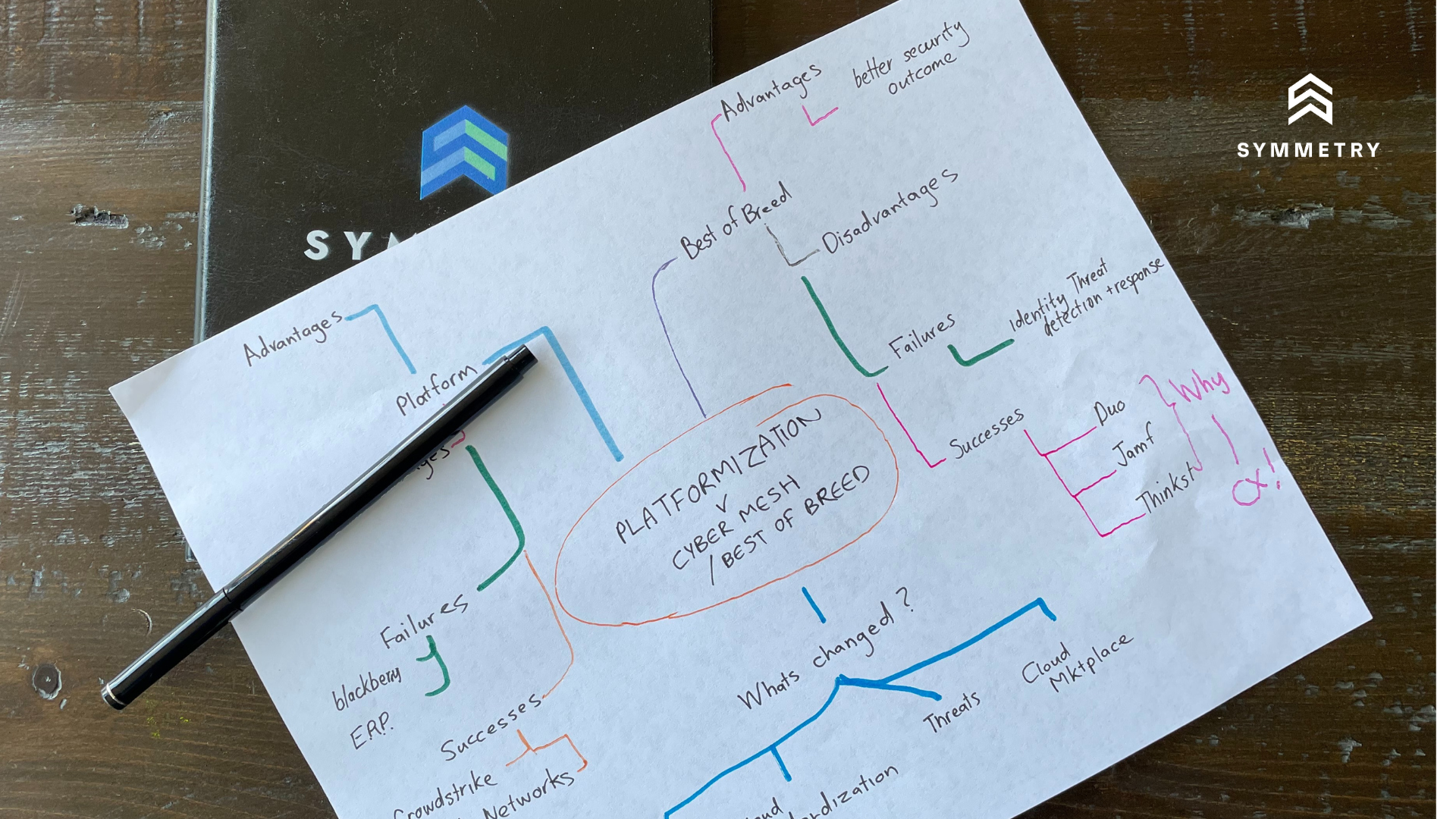
At Symmetry, we believe an integrated best of breed portfolio or “Cybersecurity Mesh” as Gartner refers to it will outperform Platformization in innovation and scale, much like a robust app store would outperform a single vendor mobile device with only the vendor’s applications. 

CISOs should focus on how to maximize the value from your investment in security tools by understanding the overlaps, gaps and opportunities in your security capabilities; and where there are potential overlaps, evaluate the effectiveness of platforms and future investments in delivering the security outcomes needed right now – not future capability.

Introduction

CISOs increasingly think they face a pivotal choice between Best-of-Breed Vendors or a Security Platformization Strategy. Whether you refer to it as “Best-of-Breed vs. Best-in-Suite” or “Platform vs. Point Solution”, it is a debate that started in the ’90s with the advent of enterprise resource planning (ERP) software. There are clear advantages and disadvantages to either approach that are well documented as outlined in Note 1.1  The adoption of single vendor ERP platforms was likewise driven by the need to reduce complexity, leverage commonalities, unify data, and minimize management overhead.

 A lot can and should therefore be learned from the failure of historical ERP deployments, where the onus was placed on the vendor to reduce the burden of integration across related systems.

Lessons Learned From ERP

Without doubt, ERP was the first real platformization approach – focusing on merging point solutions into a single platform. Before then, every back office application stood as a finely tuned point solution, meticulously designed for specific back-office tasks, be it accounts payable, payroll, or taxes. In the mid-’90s, ERP software emerged, integrating various complementary functions into a single solution and providing a unified insight to management. Customers were tired of trying to merge insights from across these systems themselves and looked to ERP platforms to solve this for them. While the theoretical benefits of tightly integrated ERP platforms are obvious, the practical realization often falls short.

Most ERP systems expanded capabilities through acquisitions, and likewise struggled to integrate themselves – leading to poorly digested integrations with more specialized systems with different code bases and often different approaches to data management. This resulted in serious integration and version-control issues, coupled with a user experience that frankly sucked. The exact same problems that platformization was attempting to address. Acquisitions that focused on code compatibility and similar data management were vastly more successful.

The approach to acquisition first and then engineering effort to enable the planned integration also had a profound impact on innovation—it essentially stifled it. Larger companies invested significant resources in post-acquisition and integration activities rather than innovating themselves, smaller more nimble companies continued to innovate independently and create more demand for M&A to keep pace. The cycle perpetuated, with promising smaller firms getting acquired and their creations attempted to be assimilated into the ERP offering.

The consequence of this acquisition and integration cycle was a set of ERP platforms that evolved into complex and costly platformization projects, posing significant challenges to manage and maintain with no choice to innovate, except through further acquisition.

What Has Changed Since Then?

Integration Has Become Easier

Since the advent of ERP systems, a confluence of technological advancements has laid a roadmap for better integration and adoption of best-of-breed solutions from multiple vendors. Central to this transformation is the widespread adoption of API-based architectures, providing standardized interfaces that facilitate seamless communication between diverse software applications. This has significantly alleviated interoperability challenges, allowing organizations to integrate specialized and innovative tools, including security with unprecedented ease. 

Nowhere is the rate of innovation driven by open integration more noticeable than in the realm of mobile app stores. These ecosystems, flourishing under the influence of API-based architectures, exemplify the advantages of encouraging developers to build on standardized hardware with open integrations. Mobile app stores have become vibrant marketplaces where diverse applications, each excelling in its specialized domain, seamlessly converge. This approach contrasts starkly with the trajectory of companies like BlackBerry, which experienced a decline due to its initially closed ecosystem reliant solely on BlackBerry-designed apps at first. The contrast between these two models underscores the transformative power of fostering an environment that promotes collaboration, interoperability, and the integration of best-of-breed solutions from various developers, ultimately shaping a landscape rich in technological diversity and continuous advancement.

The introduction of generative AI has potential to further accelerate this process by expediting the understanding and integration of outputs from a spectrum of security solutions. AI algorithms now play a crucial role in interpreting and harmonizing data, fostering a cohesive and unified security ecosystem.

Standardization of Infrastructure

Moreover, the standardization of infrastructure-as-a-service (IaaS) capabilities, offered by hyperscale cloud providers like AWS, Azure, and GCP, has created a common ground for deploying and managing diverse best-of-breed solutions. These cloud providers not only offer standardized infrastructure but also leverage cloud marketplaces, streamlining the entire process from purchasing to implementation. Cloud marketplaces provide a centralized hub where organizations can discover, procure, and deploy a variety of security solutions. This streamlined approach not only simplifies the procurement process but also enhances the integration of best-of-breed tools into existing security architectures. In essence, these collective advancements empower organizations to build a dynamic and responsive security infrastructure that seamlessly combines the specialized strengths of individual solutions, all within the flexible and scalable environment offered by cloud platforms.

Dominant Security Platforms and Solutions Focus on Single Assets

You may very well argue that dominant security platforms have emerged in the security space, and platformization is the vendor strategy of choice. Security platforms like CrowdStrike, Snyk, Palo Alto Networks and Okta.  But so have best-of-breed solutions like Duo or Thinkst Canary. The key to both? These successful platformization strategies have been most focused and most effective across asset layers as highlighted in Figure 1 below. Alternatively success has been found with integration of data from multiple layers to enable an integrated process flow and customer experience. There are clear leaders in each asset category, as a result.
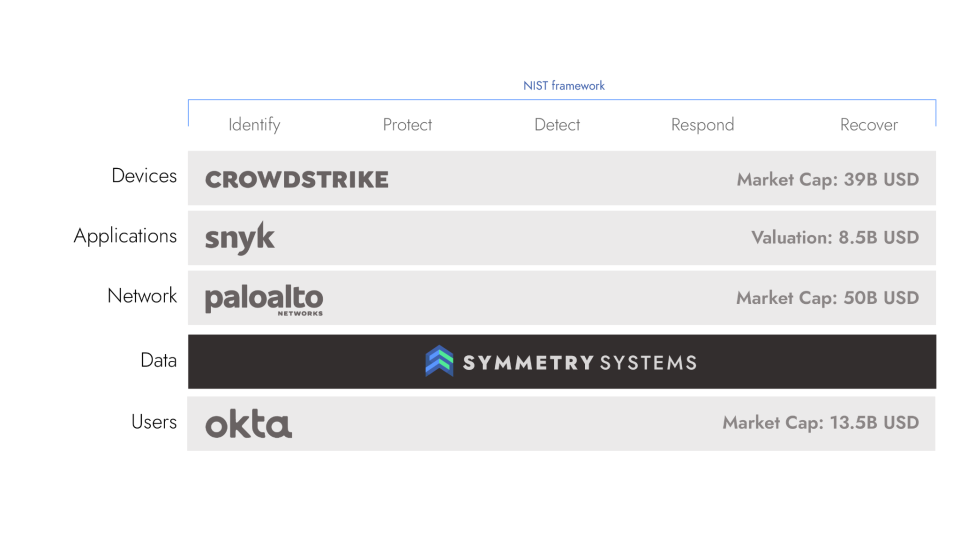
Figure 1: Analysis of the most successful Security platform approaches

Shifting Threat and Economic Landscape Focuses CISOs on Value

The contemporary threat landscape and economic outlook has obviously redefined the CISO’s challenge. CISOs need to focus more on optimizing the value of their cybersecurity spend than before. They are judged on the effectiveness in managed risk, in the face of pressure on budgets.  The debate between single vendor or multi vendor approaches has really become less important than optimizing the investment.  The question on most CISO’s minds is therefore where to focus their investment. At Symmetry, we believe that place is no longer on your perimeter network. Nor on your devices but where your most important asset “data” is at its most vulnerable “identity”.

The impact of the Shifting Landscape

It’s clear that this is no longer a debate between multi-vendor best-of-breed vs single vendor security platforms. A single unifying platform that is able to keep pace with the threat landscape not only seems unlikely. Instead judging by history of ERP and other single vendor platforms destined to quash innovation that cybersecurity desperately needs. Instead the focus should be on how to maximize the value from your investment in security tools. This requires CISOs to : 

  • delineate the lines between complementary, but slightly overlapping series of products/platforms to maximize the benefits of existing benefits using something like the Cyber Defence Matrix2
  • Evaluate the effectiveness of platforms in delivering the security outcomes needed. Can it identify, protect, detect, respond and help recover from security threats to the asset layer it is protecting?  

Along these lines, the integration between best of breed platforms emerges as the future, shaped across key asset layers. This shift is driven by the need to reduce complexity, leverage commonalities, and unified data, and minimizing management overhead. Technology consolidation spans multiple security capabilities, signaling a significant transformation in cybersecurity strategies.

Conclusion

It is clear that a lot has changed since the first ERP deployments that has transformed this decision from one designed to reduce the burden of technical integration on customers to one where CISOs can avail themselves of the best solutions with the same unified benefits of a single platform with less vendor lock-in and increased speed of innovation. These changes include:

  • The emergence and use of API-based architectures and generative AI to enable seamless and easier integration across vendors;
  • The standardization of underlying infrastructure and particularly data stores to make it easier to use common data models across applications; 
  • The emergence of dominant cybersecurity platforms focused on a more resilient approach to Cybersecurity rather than just prevention; and
  • Shifting threat and economic environment putting greater emphasis on the value rather than just cost.

The outcome is clear to us. Focus on how to maximize the value from your investment in security tools by understanding the overlaps, gaps and opportunities in your security capabilities; and where there are potential overlaps, evaluate the effectiveness of platforms and future investments in delivering the security outcomes needed right now – not future capability.

  1. Note 1: The Advantages and Disadvantages

    Best-of-Breed Security Solutions
    Embracing a best-of-breed strategy presents organizations with compelling advantages, including the delivery of focused functionality and an enhanced user experience. This approach often boasts best-in-class capabilities, allowing organizations to select specialized tools that excel in addressing specific security challenges. The flexibility to replace products as needed adds an element of adaptability. However, deploying this strategy across every asset layer and security capability may introduce more complexities than it solves. The potential for interoperability challenges and significant overlap in capabilities could hinder the seamless integration of these specialized tools and require excess headcount. Furthermore, as the industry shifts towards a detection and response paradigm, managing a diverse array of best-of-breed products becomes more intricate, amplifying complexities, talent needs and costs associated with maintaining a patchwork of specialized solutions.

    Single Vendor Security Platforms
    Conversely, security platform vendors offer a contrasting approach with the promise of a unified and integrated security landscape. These platforms aim to alleviate interoperability challenges by consolidating various security functionalities under one umbrella. Additionally, the allure of lower Total Cost of Ownership (TCO) through bundled offerings enhances their appeal. However, this approach comes with its own set of considerations. The potential for vendor lock-in raises concerns about long-term adaptability and flexibility. Moreover, in the pursuit of a unified user experience, there might be compromises in specialized features. Organizations must carefully weigh the advantages of streamlined integration against the potential drawbacks of reduced flexibility and the need to conform to a one-size-fits-all security solution. There will always be gaps in capabilities provided by the platforms.
    ↩︎
  2. Note 2: Making Sense of it all with the Cyber Defense Matrix

    Regardless of the approach, the Cyber Defense Matrix (CDM) (The brainchild of the ever impressive Sounil Yu) becomes an invaluable tool for assessing the need for best-of-breed solutions vs platforms. By leveraging the CDM, security professionals can discern the specific strengths and weaknesses within each domain, identifying areas where specialized tools may offer unparalleled advantages compared to coverage of existing platforms. This deliberate assessment helps organizations avoid unnecessary tool redundancy and ensures that each selected solution aligns with the unique requirements of the respective security layer.
    Nevertheless, the nuanced landscape of the Cyber Defense Matrix also underscores potential challenges in the best-of-breed approach. The intricate interplay of capabilities across the Matrix may reveal instances of overlap, necessitating a careful balance between deploying specialized tools and avoiding redundancy. Striking this equilibrium requires a meticulous evaluation of the organization’s cybersecurity needs, weighing the benefits of focused functionality against the potential pitfalls of tool overlap.
    As highlighted in Figure 1 above, the most effective platforms have been those focused across single asset layers or focused on integration of data from multiplier layers to enable an integrated process flow with broader context. ↩︎

Recent Blogs

About Symmetry Systems

Symmetry Systems is the Data+AI security company, providing organizations with the industry’s only comprehensive Data + AI Security Platform that discovers, classifies, protects, and monitors sensitive data across. Born from award-winning DARPA-funded research at UT Austin, our AI-powered platform delivers comprehensive Data+Ai security across all major cloud environments, SaaS applications, on-premise data stores, legacy systems, and airgapped environments. Our “get everywhere” philosophy continuously expands connector coverage to secure data wherever it lives—in all major cloud environments, SaaS applications, and on-premise data stores-including mainframes, legacy systems and airgapped environments

By uniquely merging both identity and data context, Symmetry provides what other DSPM vendors cannot: complete visibility where data exposure meets agentic identities. Organizations use our platform to eliminate unnecessary data, remove excessive permissions, accelerate compliance and cloud migration, and reduce attack surfaces – while safely enabling agentic AI systems with the identity-aware data context they require.

Innovate with confidence with Symmetry Systems.

Privacy Preferences
When you visit our website, it may store information through your browser from specific services, usually in form of cookies. Here you can change your privacy preferences. Please note that blocking some types of cookies may impact your experience on our website and the services we offer.